
Ramifications

Microbiome Ramifications

The Cambridge English Dictionary defines infection as a "condition in which bacteria or viruses that cause disease have entered the body". To prevent infections, we try to deny pathogens access to our bodies - by washing, sterilizing, employing Personal Protection Equipment [PPE], etc. This is especially important in times of elevated risk posed by infectious and virulent agents.

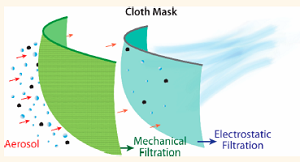
One way in which we protect outselves is by wearing PPE, namely face masks of a particular quality, capable of arresting particles and aerosols of a certain size. Face masks not only help protect us from ingesting pathogens, but also help diminish the spread of pathogens already in our bodies, expelled via aerosols through mouth and nose. The Aerosol Filtration Efficiency of Common Fabrics Used in Respiratory Cloth Masks study by Konda at al. examines the efficiency of cloth when used as filtration media for face masks intended to protect against SARS-Cov-2. Note the findings for a need to use multilayer, high Thread-Per-Inch fabrics to achieve a suitable filtration. Also note the importance of fitment, lack thereof may reduce the mask's filtration efficacy by 50% or more.

Prevailing advice from US CDC is that cloth masks should generally be avoided where possible, unless made in accordance with the above study's findings. Most importantly, making sure the face mask fits snuggly, without leakage will ensure high filtration efficacy.

Alarmingly, we notice a disturbing trend to ignore the obvious second source of pathogens - flatus. On many occasions, viable pathogens remain in the GET (thus, is present in expelled flatus) long after they are undetectable in the oral cavity. Therefore, individuals who are recovering or have recovered from an infection remain capable of spreading virus and bacteria through flatulence.

In May 2021 Dr. Andy Tagg found that flatulence could cause SARS-Cov-2 transmission after analysing a series of tests taken from coronavirus patients earlier that year. He cited tests that revealed the virus was present in the faeces of 55 per cent of patients with Covid-19 and has been detected in an asymptomatic individual up to 17 days post-exposure. Governments worldwide practice sewage testing in order to detect viral infection "hot spots".

In a NCBI literature review by Johnson at al, the fecal spread of the infection was speculated. The study showed that post flushing, the aerosolized "toilet plume" could contain fecal particles as well as the virus.

Where some claim clothing acts as a flatus filter, we submit that it is not designed with the required Threads-Per-Inch fabrics, or fit, to provide a meaningful flatus filtration. While more research is needed to establish the metrics of pathogen dissemination via flatus, the appearance of more highly transmissible viruses appears to demand emergency authorization for deployment and even mandating the use of flatus filtration technology.

©2022-23 Flatus Organization, Inc.